

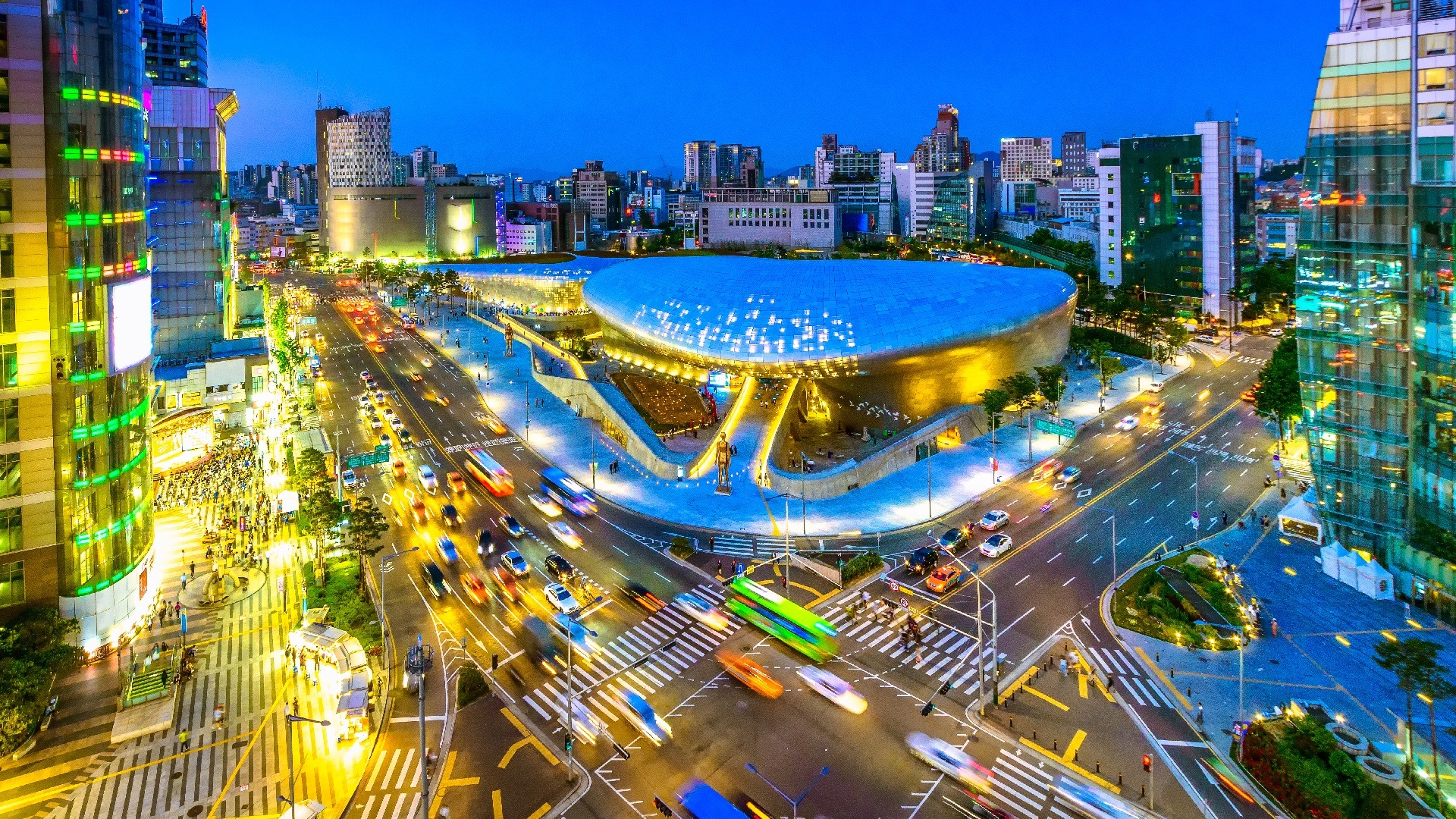
Over the last couple of years, architecture stepped beyond its conventional role. It does not just live in textbooks, museums, or city planning documents anymore; it thrives in social media feeds, travels in timelines, and becomes part of global visual culture. From the futuristic curve of Seoul to the repurposed industrial structure of London, some architectural installations have captured the world’s attention-not simply because they are buildings, but because they are experiences.
And experiences spread fast in the age of smartphones.
Seoul – Where Futurism Meets Everyday City Life

Dongdaemun Design Plaza (DDP)
The DDP by Zaha Hadid and Samoo is arguably the best example of how a building can become a global digital icon. Its smooth metallic curves seem almost alive, shifting with light throughout the day. Once a stadium, this space is now a cultural hub where fashion, design, exhibitions, and night markets merge into a single vibrant ecosystem.
What makes DDP so widely shared isn’t just its architecture — it’s the feeling of wandering through a futuristic world. Visitors often describe it as stepping into a sci-fi film, which explains why it floods Instagram and TikTok every season.
Seoullo 7017 Skygarden
Though it might sound simple, the transformation of an old highway into a linear park, Seoullo 7017 demonstrates how powerful adaptive reuse can be. Lined with trees, greenery, cafés, and observatory spots, this skywalk makes every ordinary stroll a cinematic moment, especially in the evening when the lights soften the whole structure.
It is the kind of place that encourages slow movement, pausing, and taking in the city from a new angle. And naturally, that lends itself to being highly shareable.
Creative Districts and Urban Installations
From container parks to repurposed warehouses, Seoul evolves with artistic spontaneity. Spaces that are less about stiffness and more about storytelling feature murals, pop-up installations, open plazas, and curated corners inviting you to sit, take photos, and simply be in the city.
It has mastered the balance between innovation and play.
London — A Dialogue Between the Old and the New

ArcelorMittal Orbit
Built for the 2012 Olympics, the ArcelorMittal Orbit is impossible to ignore. Its red steel structure loops up in crazy ways, like a sculpture of illogic. It’s bold, unconventional, unmistakably London in its willingness to experiment.
People don’t just visit it for the view; they visit because the structure itself feels like a piece of modern mythology.
Coal Drops Yard
Where London really shines is in marrying history with new ingenuity, and Coal Drops Yard perhaps is the most poetic testimony. From an industrial warehouse complex, the area was reinvented by Thomas Heatherwick into a contemporary shopping and social district. The “kissing roof” — where two dramatic roof arcs meet — has become one of London’s most photographed modern features.
The charm is in the contrast: old brick textures meet sleek, modern lines, creating a visual harmony that’s both nostalgic and new.
Skylines and Vertical Stories
Places like The Shard add another dimension to London’s architectural presence. Sharp, glinting, and unapologetically modern, it offers something to a skyline that tells a story of a city in constant flux and reinvention. These buildings are, more often than not, the objects of night photography, travel diaries, and reflective moments shared online.
London’s architectural identity flourishes because it embraces its contradictions: historic bridges alongside glass towers, Victorian details beneath neon reflections. This multilayered complexity, in turn, makes it endlessly photogenic.
Why These Installations Go Viral

As different as Seoul and London may be, the reasons behind the viral success of their architectural works share similar threads:
- They provide visual drama — curves, contrast, height, textures, lights.
- They create experiences – gardens in the sky, glowing plazas, intimate corners.
- They are accessible: most are open to the public, inviting constant interaction.
- They tell stories — about the past, the future, and the identity of a city.
People are taking pictures not only of buildings but also of how the buildings make them feel.
What Other Cities Can Learn Indeed
The rise of architectural installations to global social media proves that cities do not need to chase grandeur to gain attention. What they need is intent: designing spaces that invite people to gather, wander, pause, and connect.
Architecture becomes powerful when it becomes personal-when it makes someone stop in their tracks, lift their phone, and want to share the moment with the world.

